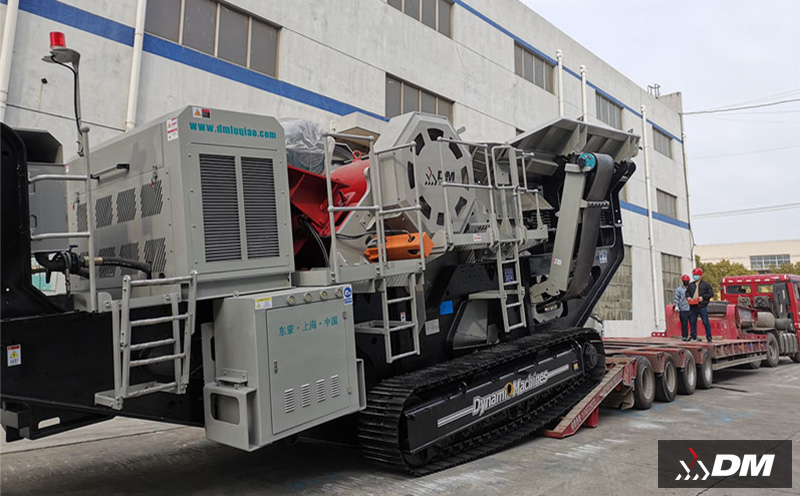
In the global aggregates, mining, and construction waste recycling industries, project managers and contractors frequently encounter logistical nightmares. Remote quarry sites often lack road access, making the transport of massive fixed crushers impossible or prohibitively expensive. Urban demolition projects face strict space constraints and environmental regulations, rendering traditional stationary plants unviable. Furthermore, linear infrastructure projects like highways and railways require crushing stations that can migrate with the workface. In these scenarios, the limitations of fixed plants and even tire-mounted mobile crushers become glaring bottlenecks. The solution lies in the superior mobility and self-sufficiency of the tracked mobile jaw crusher.
Addressing Core Pain Points: Mobility Meets Productivity
The primary pain point in complex terrain is accessibility. Fixed plants require extensive civil engineering, including concrete foundations and steel structures, which can take months to build and demolish. Tire-mounted mobile crushers, while movable, rely on external towing and often struggle in soft, muddy, or steep conditions without prepared roads. The tracked mobile jaw crusher eliminates these barriers. Its crawler chassis provides exceptional ground clearance and low ground pressure, allowing it to traverse wetlands, climb gradients of up to 20 degrees, and navigate tight spaces with precision. This "go-anywhere" capability means the crusher can be positioned directly at the extraction face or demolition zone, drastically reducing haulage distances and associated fuel costs.
The Solution: Integrated Design and Hydraulic Power
A tracked mobile jaw crusher is a fully integrated processing plant. It combines a heavy-duty feeder, a high-performance jaw crusher, and discharge conveyors onto a single, self-propelled chassis. The use of fully hydraulic drive systems for both tracking and crushing functions ensures smooth operation and precise control. Modern units often feature hybrid drive systems, allowing them to plug into the local grid when available to reduce carbon footprint and fuel costs, or switch to onboard diesel engines for remote operations.
Crucially, these machines are designed for rapid deployment. Upon arrival at a new site, hydraulic legs stabilize the unit, and side conveyors fold out in minutes. There is no need for bolting the machine to the ground or pouring concrete. This "plug-and-play" philosophy allows contractors to respond instantly to market demands or project changes, turning what was once a logistical hurdle into a competitive advantage.
Application Scenarios: Versatility Across Industries
The versatility of the tracked mobile jaw crusher makes it indispensable across multiple sectors. In quarrying, it serves as the primary crusher, processing blasted rock directly at the pit face. This is particularly valuable in multi-bench quarries where the working face shifts annually. In construction waste recycling, the machine’s ability to handle rebar and concrete, often aided by integrated magnetic separators, allows for on-site processing of demolition debris into high-value recycled aggregates. For road and rail construction, the unit can be relocated every few kilometers to match the paving progress, ensuring a steady supply of base material without the downtime associated with moving fixed plants.
Selection Logic and Operational Excellence
Selecting the right tracked mobile jaw crusher requires a thorough analysis of the application. Key factors include the maximum feed size, required throughput, and material abrasiveness. For hard rock mining, a unit with a robust jaw chamber and high-torque drive is essential. For recycling, features like hydraulic crusher reversal (to clear blockages) and effective dust suppression systems are paramount.
Operational excellence hinges on proactive maintenance. While tracked crushers are equipped with advanced PLC control systems and remote monitoring capabilities, physical inspections remain vital. Regular checks of track tension, undercarriage wear, and hydraulic hose integrity can prevent catastrophic failures. Leveraging telematics data allows fleet managers to optimize maintenance schedules based on actual engine hours and load factors rather than arbitrary calendar dates, further enhancing uptime.
ROI Analysis: The Economic Case for Mobility
The Return on Investment (ROI) for a tracked mobile jaw crusher is often realized faster than anticipated when factoring in total operational savings. While the initial capital expenditure may be higher than a tire-mounted equivalent, the savings are substantial:
- Eliminated Civil Works: Saving hundreds of thousands of dollars in foundation costs.
- Reduced Haulage: Crushing at the source cuts trucking costs and fuel consumption significantly.
- Labor Efficiency: One operator can often manage the entire unit via remote control, reducing on-site personnel requirements.
- Asset Utilization: The ability to move between projects ensures the asset generates revenue year-round, rather than sitting idle during site transitions.
In conclusion, the tracked mobile jaw crusher is more than just a piece of equipment; it is a strategic solution for modern, dynamic crushing operations. By overcoming geographical and logistical barriers, it empowers contractors and miners to extract value from previously inaccessible or uneconomical deposits. For businesses operating in today’s volatile and demanding market, the flexibility and efficiency offered by tracked mobility are not just advantages—they are necessities for sustainable growth and profitability. 

Related Articles
Portable Screening on Job Sites: Tracked Screening Machine Guide
2026-08-11 More+Need to produce sized aggregates at multiple job sites without hauling? Learn ho...
How to Improve Profitability in a Construction Waste Recycling Plant
2026-06-05 More+Why Some Construction Waste Recycling Plants Struggle to Make ProfitsMany invest...
Solutions to the Difficulties of Urban Construction‑Waste Governance
2026-08-12 More+With accelerated urbanisation, continuous old‑town demolition and municipal reno...
What procedures are required for a construction waste treatment plant?
2026-04-24 More+The establishment of a construction waste treatment plant (resource recycling &a...
Construction Waste Recycling Crusher - Construction Waste Recycling & Reuse
2026-06-24 More+With the continuous advancement of urbanization across the globe, massive solid ...
The Ministry of Ecology and Environment arranges major tasks for ecological environmental protection in the 15th Five-Year Plan.
2026-04-24 More+On April 11, the Ministry of Ecology and Environment held a symposium in Beijing...
Application Guide for Crushing and Screening Products in Construction Waste Resource Utilization
2026-04-24 More+Focusing on the core goals of reduction, recycling and harmless treatment for co...
Construction waste's savior- Brick Crusher
2026-07-08 More+With the accelerated progress of urbanization worldwide, demolition and reconstr...
On-Site Primary Crushing: Tracked Mobile Jaw Crusher Guide
2026-08-04 More+Tired of hauling oversized rock from remote sites? Learn how the Shanghai Dongme...
Demolition Project Construction Waste Disposal Solution - Complete Crushing and Screening Equipment Layout Plan
2026-06-11 More+With the continuous progress of urban renewal, old building demolition and facto...