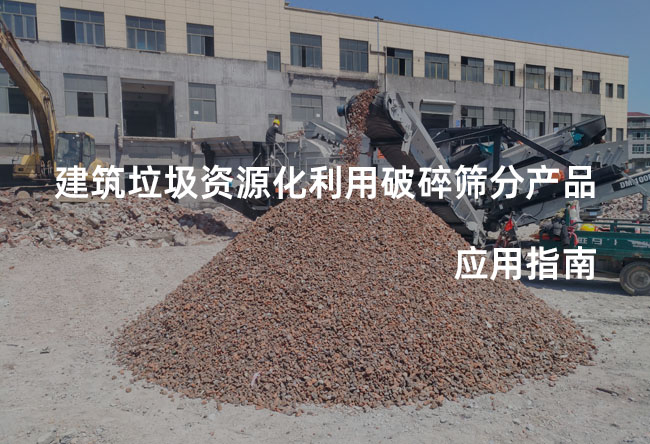
I. Core Application Orientation and Policy Basis
(1) Application Orientation
Focusing on the core goals of reduction, recycling and harmless disposal for construction waste, we adopt the full-process crushing and screening technology to convert demolition waste, decoration waste, engineering muck and other materials into high-value products including recycled aggregates, recycled products and inorganic mixtures. Widely applied in construction, municipal engineering, transportation, water conservancy and other fields, it helps build a circular economy system of "resources – products – waste – renewable resources".
(2) Policy Basis
- General Office of the State Council, Opinions on Further Strengthening Urban Construction Waste Management (Guo Ban Han〔2025〕No. 57): It clarifies that by the end of 2027, the average resource utilization rate of construction waste in prefecture-level and above cities nationwide shall exceed 50%. It requires classified treatment of construction waste, priority production of recycled aggregates and recycled building materials, and priority procurement of recycled products for financial-funded projects.
- Comprehensive Solid Waste Treatment Action Plan: It proposes to greatly increase the annual comprehensive utilization volume of construction waste by 2030, accelerate the issuance of technical specifications and product quality standards for construction waste recycling, and improve the whole-chain supervision mechanism.
- Local supporting standards: such as Guidelines for Application and Quality Control of Construction Waste Recycled Products and Technical Guidelines for Application of Construction Waste Recycled Aggregates in Road Engineering, which refine technical requirements and application scenarios for crushing and screening equipment.
II. Core Crushing & Screening Processes and Equipment Selection
(1) Typical Process Flow
Following the core process of pretreatment → crushing → screening → separation and impurity removal → deep processing, it adapts to different types of construction waste and end-product requirements:
1. Pretreatment Stage
- Core operation: Manual & mechanical sorting to separate impurities such as steel bars, wood, plastics and rock wool; bulk materials (≤1000mm) are pre-crushed by hydraulic breakers. Domestic waste and hazardous waste are strictly prohibited from mixing in.
- Key equipment: Vibrating feeder / apron feeder (uniform feeding), manual sorting platform, iron remover (scrap metal recovery).
- Core indicators: Impurity removal rate ≥98%, to prevent equipment wear and unqualified product purity.
2. Crushing Stage
- Process combination:
- General process: Primary coarse crushing + secondary fine crushing (suitable for most recycled aggregate production);
- High-quality aggregate process: Primary coarse crushing + secondary medium crushing + tertiary fine crushing & shaping (to optimize aggregate particle shape);
- In-situ disposal process: Two-stage crushing + five-stage screening + multi-stage separation (for projects with an annual capacity of 500,000–1,000,000 tons).
- Equipment selection and applicable scenarios:
| Equipment Type | Core Function | Applicable Scenarios | Key Parameters |
|---|
| Jaw Crusher | Coarse crushing for bulk materials | Demolition waste, reinforced concrete blocks | Feed size ≤1000mm, discharge size ≤250mm |
| Impact Crusher | Medium/fine crushing, particle shape optimization | Concrete-based construction waste | Discharge size ≤40mm, excellent grain shape |
| Cone Crusher | Medium/fine crushing for high-hardness materials | Hard aggregate processing such as basalt | Suitable for high-strength recycled aggregate production |
| Vertical Shaft Impact Crusher | Fine crushing & shaping, gradation improvement | High-quality recycled aggregates, recycled concrete | Discharge size ≤20mm, low flaky & elongated particle content |
3. Screening Stage
- Core operation: Particle size classification; oversize materials are returned to the crushing section for closed-circuit circulation to improve resource utilization.
- Mainstream equipment and parameters:
- Linear vibrating screen: efficiency ≥95%, suitable for large and medium-sized production lines, classified sizes: 0-5mm, 5-10mm, 10-25mm, 25-31.5mm;
- Circular vibrating screen: small footprint, suitable for mobile / small-scale lines with flexible mesh adjustment;
- Bar composite screen: for primary screening to separate muck and bulk materials.
4. Separation and Impurity Removal Stage
- Process options: Dry process (preferred, no water treatment required), wet process (high mud content materials), combined dry-wet process;
- Key equipment: Vibrating air separator (removes light impurities such as plastics and wood chips, separation rate ≥95%), magnetic separator (secondary iron removal), near-infrared color sorter (to enhance aggregate purity).
(2) Key Points for Production Line Design
- Capacity matching: Decoration waste line: 60~120t/h; demolition waste line: 100~250t/h; mobile lines for decentralized projects.
- Environmental protection configuration: Fully enclosed production lines, equipped with bag dust collectors, fog cannons (dust ≤10mg/m³) and wastewater treatment equipment (recycled water reuse).
- Closed-loop design: Oversize materials are returned to medium crushing equipment to form a balanced closed loop, improving output and raw material utilization.
III. Classification and Application Scenarios of Crushed & Screened Products
(1) Recycled Aggregate Classification & Technical Indicators
In accordance with the Guidelines for Application and Quality Control of Construction Waste Recycled Products, recycled aggregates are divided into Grade Ⅰ–Ⅴ by performance. Core indicators and applicable scenarios are as follows:
| Aggregate Grade | Core Key Indicators | Applicable Scenarios |
|---|
| Grade Ⅰ | Alkali-aggregate reaction expansion <0.10%; crushing value ≤20% | Non-structural ready-mixed concrete, non-prestressed precast components, highway/municipal road base courses, non-load-bearing wall panels |
| Grade Ⅱ | Qualified alkali-aggregate reaction; crushing value ≤23% | Non-structural concrete, municipal road base courses, sponge city filter layers |
| Grade Ⅲ | Crushing value ≤26% | Non-structural concrete, road subbase/cushion layers, foundation backfilling, sponge city water storage layers |
| Grade Ⅳ | Crushing value ≤30% | Flowable filling materials, non-fired bricks, road cushions, pipe trench backfilling |
| Grade Ⅴ | Meeting general backfilling requirements | Flowable filling materials, road cushions, foundation backfilling |
(2) Derivative Products & Application Scenarios
1. Recycled Sand & Powder
- Classification: Class A (for cement concrete & mortar), Class B (for foam concrete & blocks), Class C (for inorganic mixtures & backfilling);
- Application: Recycled permeable bricks, plastering mortar, road inorganic mixtures, etc.
2. Recycled Finished Products
- Recycled permeable bricks: compressive strength ≥30MPa, permeability coefficient ≥1.0×10⁻²cm/s, applied to sidewalks, squares and parking lots (sponge city);
- Recycled masonry materials: recycled solid bricks & perforated bricks for non-load-bearing walls, boundary walls and pipe trenches;
- Slope protection / retaining wall blocks: recycled aggregate replacement rate ≥50%, applied to river revetments and road slope protection.
3. Inorganic Mixtures
- Recycled stabilized materials: used for expressway and municipal road base & subbase courses, replacing natural stabilized materials and cutting costs by 20%–30%;
- Flowable solidified soil: daily output up to 3000m³/d, replacing backfill sand and compacted subgrade soil for road widening and abutment backfilling.
4. Backfilling Materials
- Blended recycled aggregates: max particle size ≤50mm for foundation pit backfilling, ≤40mm for pipe trench backfilling, ≤10mm around pipe joints;
- Engineering muck filling materials: for road embankments and dike projects, compatible with compacted solidified soil technology.
IV. Quality Control and Acceptance Standards
(1) Key Quality Control Points
- Raw material control: No domestic waste or hazardous waste mixing; raw material particle size ≤1000mm.
- Process control:
- Crushing granularity: primary crushing ≤250mm, secondary crushing ≤100mm, fine crushing ≤20mm;
- Screening accuracy: classification error ≤5%, oversize material circulation rate ≤10%;
- Impurity removal effect: light material separation rate ≥95%, aggregate impurity content <0.2%.
- Environmental control: dust ≤10mg/m³, noise ≤70dB(A), wastewater recycling rate ≥80%.
(2) Acceptance Standards
- Recycled aggregates: comply with Pebble and Crushed Stone for Construction (GB/T 14685), inspected by Grade Ⅰ–Ⅴ; crushing value, alkali-aggregate reaction and mud content shall be sampled and tested per batch.
- Recycled products: recycled permeable bricks comply with Permeable Pavement Bricks and Slabs (GB/T 25993); recycled bricks comply with Construction Waste Recycled Aggregate Solid Bricks (JG/T 505).
- Engineering acceptance: road base recycled stabilized materials comply with Municipal Road Construction & Quality Acceptance Code (CJJ 1); compaction coefficient of backfill materials ≥0.93.
V. Typical Application Cases
Case 1: Construction Waste Recycling Project, Chaoyang District, Beijing
- Scale: Annual disposal capacity of 480,000 tons; adopting "two-stage crushing + five-stage screening + multi-stage separation" process;
- Core equipment: jaw crusher, impact crusher, vibrating air separator, multi-stage vibrating screens;
- Output: 0-5mm, 5-10mm, 10-25mm, 25-31.5mm recycled aggregates; resource utilization rate 95%, aggregate impurity content <0.2%, applied to secondary highway base courses;
- Environmental performance: dust emission <20mg/m³, noise ≤70dB(A), full wastewater recycling.
Case 2: Municipal Road Recycled Aggregate Application Project
- Project: Main urban road base construction adopting recycled stabilized materials to replace natural raw materials;
- Raw materials: Grade Ⅱ recycled coarse aggregates (crushing value 22%) produced from crushed demolished concrete;
- Effects: 25% reduction in raw material cost, 15% improvement in construction efficiency, qualified road base strength, passing both environmental and quality acceptance.
VI. Implementation Suggestions and Risk Prevention & Control
(1) Implementation Suggestions
- Preliminary investigation: Clarify construction waste type (demolition / decoration / mixed), disposal scale and target products to match processes and equipment.
- Process optimization: Concrete-dominant materials adopt "jaw crushing + impact crushing + shaping"; brick-tile-dominant materials adopt "jaw crushing + double-tooth roller crushing" to upgrade product quality.
- Compliant layout: Site selection in line with urban planning, complete environmental protection facilities, and complete environmental impact assessment & solid waste disposal formalities.
- Market connection: Prioritize cooperation with municipal road, sponge city and real estate projects to build stable consumption channels.
(2) Risk Prevention & Control
- Raw material risk: Sign long-term cooperation agreements with waste producers to ensure stable supply and excessive impurity prevention.
- Quality risk: Establish a three-level testing system covering raw materials, production processes and finished products; issue inspection reports per batch and ban unqualified products from delivery.
- Environmental risk: Regular maintenance of dust removal, noise reduction and wastewater facilities to ensure compliant discharge and avoid environmental penalties.
- Market risk: Expand multi-scenario applications (construction, transportation, water conservancy) to reduce industry reliance and strengthen brand promotion.
VII. Appendix: Core Standards & Key Terms
(1) Core Standards
- Technical Standard for Construction Waste Treatment (CJJ/T 134)
- Pebble and Crushed Stone for Construction (GB/T 14685)
- Recycled Aggregate Solid Bricks Made from Construction Waste (JG/T 505)
- Technical Guidelines for Application of Construction Waste Recycled Aggregates in Road Engineering
(2) Key Terms
- Recycled Aggregate: Aggregates produced by crushing, screening and separating construction waste, used to replace natural sand and stone.
- Closed-circuit Circulation: A processing mode where oversize materials are returned to crushing equipment for reprocessing to improve raw material utilization.
- Light Impurities: Low-density contaminants in construction waste such as plastics, wood chips and textiles.
- Crushing Value: A core index reflecting aggregate crushing resistance, directly affecting structural strength of engineering works.


Related Articles
Stationary Impact Crusher: Advantages, Working Principle and Application Scenarios
2026-08-28 More+1. Introduction to Stationary Impact CrusherStationary impact crusher is sp...
Comprehensive Analysis of Crushers: Types, Applications, Selection and Operation‑Maintenance Guide
2026-09-08 More+Crushers are core equipment for mineral mining, infrastructure construction, con...
Upgrade Aggregate Shape with Fixed Impact Crusher Plants
2026-07-28 More+Low flaky content and cubical aggregate command premium prices. Discover how the...