On remote construction sites, small quarries, and infrastructure projects scattered across large areas, one of the biggest cost drivers is hauling. Oversized blasted rock or excavated stone has to be trucked to a fixed crushing plant, sometimes over long distances on poor roads, before it can be reduced to a usable size. Every kilometre of haul adds cost, emissions, and schedule risk. For operators who need primary crushing at multiple locations or on temporary sites, a tracked mobile jaw crusher offers a simple but powerful answer: bring the crusher to the rock, not the rock to the crusher.
The Pain Point: Hauling Oversized Rock Is Expensive and Slow
Fixed primary crushing plants work well when the ore or quarry face is stable and nearby. But on road projects, dam sites, urban demolition jobs, and small scattered quarries, the material source moves or is spread out. Hauling large, bulky rock to a central plant ties up trucks, wears out roads, and eats into margins. Setting up a temporary fixed crusher takes weeks of civil work and is rarely worth it for short projects. The result is that many operators either overpay for haulage or accept lower productivity and higher cost per tonne than they should.
The Solution: Self-Propelled Primary Crushing That Goes to the Material
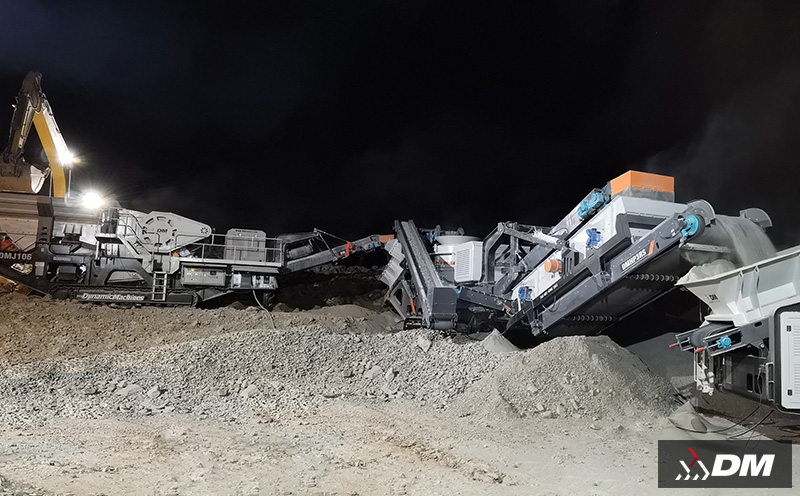
The Shanghai Dongmeng Group tracked mobile jaw crusher packages a heavy-duty jaw crusher onto a crawler chassis, creating a complete primary crushing unit that drives itself to the material and starts producing in a very short time.
- Tracked mobility on rough terrain: The self-propelled crawler undercarriage climbs slopes, crosses muddy ground, and navigates tight spaces without needing a low-loader or disassembly. Moving between work zones takes hours, not days.
- Large feed opening for big rock: The deep, wide jaw chamber accepts large, blocky feed directly from blasting or excavation, reducing the need for secondary breaking or resizing on site.
- Heavy-duty crushing performance: A robust frame, reinforced jaw, and high-torque drive deliver reliable primary reduction of hard, abrasive rock, producing a consistent product size for downstream processing.
- Integrated feeder and conveyor: Built-in vibrating feeder and discharge conveyor make the unit self-contained—no separate feed system is required to start crushing.
When followed by a mobile cone or impact crusher and a mobile screening machine, the tracked jaw crusher anchors a complete portable crushing-and-screening train that produces finished aggregate on site.
Application Scenarios: Primary Crushing Wherever You Need It
A tracked mobile jaw crusher adds value across a wide range of primary crushing tasks. In road and highway construction, it processes excavated rock and blasted material along the alignment, producing crusher-run base and feed for further sizing right where it is needed. On hydropower and dam projects in mountainous terrain, it reduces blasted rock for embankment and concrete aggregate without building a permanent plant. In small and medium quarries with multiple faces, it moves between benches to keep production close to the working face, cutting internal haulage. In urban demolition and recycling, it handles large concrete chunks and demolition debris on site, reducing truck traffic and disposal cost. It also serves temporary borrow pits, mine site development, and emergency rock supply for infrastructure projects.
Customer Benefits: Lower Haul Cost, Faster Startup
The economic advantages of on-site primary crushing are substantial. First, hauling savings are immediate and significant—processing rock on site eliminates round-trip trucking of bulky oversize material, reducing fuel, labour, road maintenance, and permitting costs. Second, fast startup means production can begin within hours of arrival, which is critical for tight project schedules and short-duration jobs. Third, flexibility lets one machine serve multiple sites or projects over its life, keeping utilization high and spreading capital cost across more tonnes. For contractors and project-based operators, this combination of savings and flexibility often transforms the economics of a job.
Selection Logic: Size the Jaw for the Feed and the Job
Choosing the right tracked mobile jaw crusher depends on several key factors. Maximum feed size determines the required feed opening—always leave margin to avoid bridging and downtime. Material hardness and abrasiveness guide chamber design and jaw plate material; harder, more abrasive rock calls for heavier-duty construction and premium manganese plates. Target capacity must match both the project's daily tonnage and any downstream equipment, so the primary stage does not bottleneck the rest of the train. Site conditions such as space, slope, and ground bearing also matter—narrow urban sites may favour compact models, while remote quarries benefit from larger, higher-capacity units. Shanghai Dongmeng Group evaluates each project's feed, throughput, and site conditions to recommend the optimal mobile jaw crusher configuration.
Operation and Maintenance: Protect Uptime in the Field
Mobile jaw crushers work in tough conditions, so disciplined operation and maintenance are essential to protect availability. Operators should feed the crusher evenly and consistently to avoid uneven wear and overload. Daily checks should include jaw plate wear and tension, lubrication levels, belt condition, and track undercarriage status. Jaw plates should be rotated or replaced before they wear down to the point of reduced efficiency or frame damage. The machine's modular design and accessible service points speed up routine maintenance, while Shanghai Dongmeng Group supports customers with fast delivery of genuine wear parts and remote technical assistance to minimize downtime in the field.
Return on Investment: Mobility Drives Utilization and Payback
For operators who work across multiple sites or on time-sensitive projects, the tracked mobile jaw crusher typically delivers a strong return on investment. Payback comes from three directions: reduced hauling cost, faster project startup, and higher utilization across jobs. In regions where transport costs are high or project schedules are tight, the unit can often pay for itself within the first one to two years. Because it retains its mobility and value over time, it continues generating revenue on future projects long after the initial investment has been recovered—an advantage that stationary primary crushers cannot match for distributed or temporary work.
Conclusion
Primary crushing does not have to happen at a fixed plant. For remote sites, linear projects, and scattered quarries, a
tracked mobile jaw crusher brings reliable, heavy-duty primary crushing directly to the material, cutting hauling costs, speeding up startup, and improving utilization. With rugged crawler mobility, large feed capacity, and proven jaw crushing performance, it helps contractors, quarry operators, and infrastructure developers do more with less—wherever the rock is. Shanghai Dongmeng Group partners with customers to deploy mobile primary crushing solutions that move with the job, delivering productive, cost-effective crushing on every site.


Related Articles
Construction Waste Recycling Plants Are Moving Closer
2026-06-09 More+Urban Renewal Is Reshaping the Construction Waste Recycling IndustryChina's...
Solid Waste Treatment Plant Complete Production Line Supplier
2026-06-18 More+Solid Waste Treatment Plant · The Shift in Perception: Turning Solid Waste from ...
Mobile Screening on Site: Tracked Screening Machine for Every Job
2026-07-17 More+Need to sort aggregates, recycle C&D waste, or scalp material across multipl...
Boost Quarry Profit with Fixed Cone Crushing
2026-07-07 More+A practical guide for quarry and aggregate producers on using a fixed cone crush...
What procedures are required for a construction waste treatment plant?
2026-04-24 More+The establishment of a construction waste treatment plant (resource recycling &a...
Stationary Screening Plants: Boost Quarry Output & Quality
2026-08-07 More+Is your screening stage holding back production and product quality? Discover ho...
Ten Common Failures of Sand Making Machine and Corresponding Solutions
2026-07-02 More+In the modern manufactured sand production industry, sand making machine serves ...
Urban Construction Waste Treatment Project Case — One-stop Service from Dongmeng Heavy Industry
2026-06-25 More+In the context of urban renewal and the construction of zero-waste cities, the d...
Construction Waste Recycling Crusher - Construction Waste Recycling & Reuse
2026-06-24 More+With the continuous advancement of urbanization across the globe, massive solid ...
Solutions to the Difficulties of Urban Construction‑Waste Governance
2026-08-12 More+With accelerated urbanisation, continuous old‑town demolition and municipal reno...