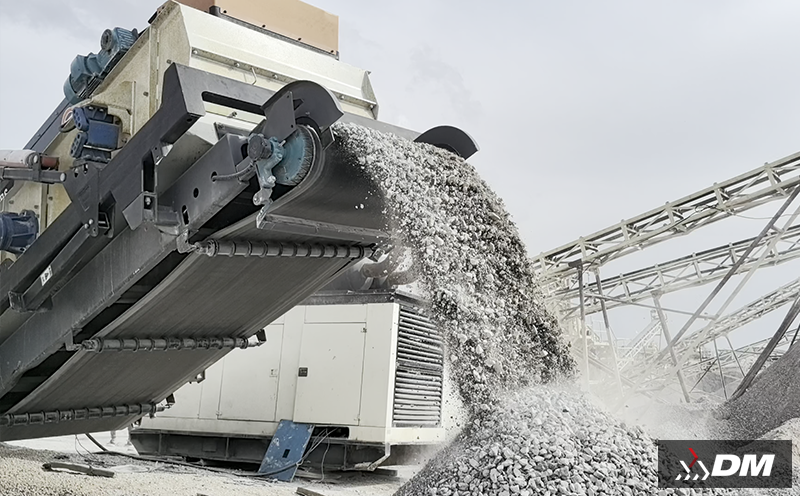
Not all construction waste is the same.
Different projects generate different material compositions.
Urban Demolition Waste
Typically contains:
-
Concrete
-
Bricks
-
Reinforcing steel
This material usually has high recycling value.
Industrial Demolition Waste
Often includes:
-
Granite blocks
-
Stone waste
-
High-strength concrete
These materials require more robust crushing systems.
Renovation Waste
Common components include:
-
Gypsum board
-
Wood
-
Plastic
-
Glass
Sorting efficiency becomes especially important.
Why Granite Content Changes Everything
Many recycling projects overlook the importance of material hardness.
Granite and other hard rock materials significantly influence:
-
Equipment wear
-
Power consumption
-
Production stability
Consider the following comparison:
| Parameter | Standard Concrete | Granite-Rich Feed |
|---|
| Abrasiveness | Medium | High |
| Wear Cost | Lower | Higher |
| Crusher Load | Moderate | Heavy |
| Maintenance Frequency | Lower | Higher |
For projects containing substantial granite waste, selecting the correct crushing technology becomes critical.
Choosing the Right Crushing Process
Option 1: Jaw Crusher + Impact Crusher
Advantages:
-
Lower initial investment
-
Good particle shape
Disadvantages:
-
Higher wear costs in hard rock applications
-
More frequent maintenance
Advantages:
-
Better for granite and hard concrete
-
Lower long-term wear costs
-
Improved operating stability
Disadvantages:
-
Higher initial capital investment
For facilities processing more than 300 TPH of hard material, cone crusher systems often provide better long-term economics.
Material Composition
-
Reinforced concrete
-
Granite waste
-
Asphalt pavement
-
Bricks
Maximum Feed Size
950 mm
Working Conditions
-
Continuous operation
-
Urban demolition project
-
Strict environmental regulations
Equipment Configuration
Heavy-Duty Feeder
Ensures stable material flow.
Mobile Jaw Crusher
Handles primary crushing.
Cone Crusher
Processes hard granite fractions efficiently.
Multi-Deck Screening System
Produces:
-
Recycled sand
-
Recycled aggregate
-
Road base materials
Metal Separation System
Recovers valuable steel components.
Actual Operating Results
Capacity
380–420 TPH
Daily Operating Time
11 Hours
Aggregate Recovery Rate
Approximately 87%
Electricity Consumption
Reduced by 12–15% compared with older plant designs.
Maintenance Costs
Reduced by approximately 20% through optimized process design.
Why Product Quality Determines Revenue
Many operators focus on throughput.
However, customers increasingly demand:
Consistent Aggregate Gradation
Stable particle distribution improves market acceptance.
Lower Impurity Levels
Reduced contamination increases product value.
Better Particle Shape
High-quality recycled aggregates command stronger pricing.
Facilities producing premium recycled materials can often achieve substantially higher margins than plants focused solely on disposal.
Environmental Compliance Is Becoming a Competitive Advantage
China's transition toward a circular economy and "Zero-Waste City" development is encouraging greater investment in advanced recycling infrastructure.
Today, successful construction waste recycling plants typically include:
Dust Suppression Systems
For cleaner operation.
Noise Reduction Measures
Especially important in urban projects.
Closed Material Conveying
Improves environmental performance.
Intelligent Process Control
Reduces labor dependence and improves efficiency.
Looking Ahead: What Will Define Successful Recycling Plants?
The next generation of construction waste recycling facilities will not compete solely on capacity.
Instead, competitive advantages will increasingly come from:
Lower Cost per Ton
Optimized operating expenses.
Higher Recovery Rates
More valuable recycled products.
Greater Automation
Improved operational efficiency.
Better Environmental Performance
Compliance with future regulations.
As China's urban renewal projects continue and circular economy policies expand, construction waste recycling plants will become a vital component of sustainable infrastructure development.
Shanghai Dongmeng remains committed to providing innovative crushing, screening, and recycling solutions that help customers maximize resource recovery while achieving long-term profitability and environmental sustainability.


Related Articles
Jaw crusher host suddenly shut down? Don't be afraid! First check to see if it is due to these reasons!
2026-07-15 More+In global mining, aggregate processing and construction waste recycling industri...
4 Cons of Mobile Jaw Crusher To Consider & How Reliable Manufacturers Solve These Pain Points
2026-07-01 More+In global aggregate quarries, open-pit mines and construction waste recycling pr...
How to Adjust Heavy‑Duty Vibrating Feeder? Practical On‑Site Debugging Tips
2026-09-19 More+For sand‑aggregate and construction waste crushing sites, poor commissioning of ...
How Moisture Content Affects Construction Waste Plant Performance
2026-06-12 More+Moisture Content Is Often the Hidden Factor Behind Poor Plant PerformanceWhen ev...
How to Resolve Plugging Materials of Jaw Crusher?
2026-08-27 More+During rock‑crushing operations in quarries, mineral‑processing plants and const...
How to Maintain a Vibrating Screen?
2026-09-27 More+The vibrating screen is the core screening equipment in sand, aggregate and mini...
How to Select a Manufacturer of Construction Waste Treatment Equipment? Shanghai Dongmeng Mobile Crushing Station Realizes Waste Recycling
2026-08-26 More+With the continuous advancement of urban renewal, old‑city demolition and road r...
How to Choose Crusher Manufacturers: 2026 Purchasing Guide and Strength Screening Tips
2026-09-04 More+1. Introduction: Selecting the Right Crusher Manufacturers Is Critical for Long‑...