
How to Maintain a Vibrating Screen?
2026-09-27

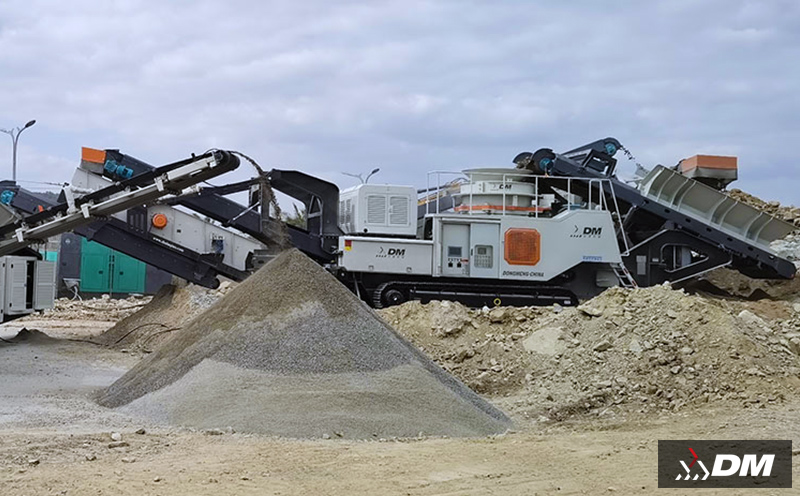
Hard rock quarry operators do not usually lose money because they lack reserves. They lose money because material movement, secondary crushing, and production coordination do not work as one system. This is especially true in remote mountainous quarries, island projects, and scattered rock extraction sites where every extra truck movement, every unplanned shutdown, and every mismatch between blasting and crushing has a direct effect on cost per ton.
Many producers initially focus on primary crushing or on the final product screens, assuming the middle stage will take care of itself. In reality, the secondary and tertiary stages often determine whether the site can produce a steady flow of sellable aggregates. When blasted rock leaves the face in uneven sizes, when haul roads are long, and when different benches must be worked in phases, a fixed arrangement can become a bottleneck. That is where a tracked mobile cone crusher becomes more than a machine. It becomes a flexible operating strategy.
For overseas quarry owners, contractors, and aggregate producers, the real question is not whether a mobile solution looks attractive in a brochure. The real question is whether it solves daily operating pain: inconsistent feed, high relocation effort, production interruptions between zones, diesel and labor waste from double handling, and poor utilization of downstream screens. A properly deployed tracked mobile cone crusher can address exactly those issues and help remote sites turn variable rock conditions into consistent output.
A remote quarry is never only about crushing rock. It is about moving men, parts, fuel, service support, and finished material in a location where none of those things are easy. If a fixed plant is placed too far from the active face, haulage distance grows over time. If the blasted material changes from one bench to another, the crushing setup that worked last month may no longer deliver the same reduction or shape. If a site has to open satellite extraction areas, duplicating civil works is expensive and slow.
These risks are manageable in theory, but in practice they often create chronic inefficiency. Trucks wait. Loaders rehandle material. Feed becomes irregular. Downstream screens either run underloaded or get hit by surges. The plant manager then sees the problem as a capacity issue, while the finance team sees it as a cost problem. Both are right, but the root cause is usually an inflexible process layout.
A tracked mobile cone crusher changes that equation by allowing the crushing stage to move closer to where the rock is actually being produced. That alone can reduce internal haul distances, simplify material flow, and limit unnecessary stockpile handling. More importantly, it gives the operation a way to respond to changing geology and production priorities without rebuilding the entire process around a fixed footprint.
In many hard rock operations, primary crushing is already established and relatively stable. The next challenge is turning that output into a consistent feed for final sizing. If secondary crushing is too rigid, the whole plant suffers. Material may be transported farther than necessary. Intermediate stockpiles grow in the wrong place. Operators must run extra shifts just to clear accumulated feed. Product quality becomes more variable because the crusher is being forced to operate outside its best working window.
This is where the tracked mobile cone crusher has practical value. It allows the operation to place secondary crushing capacity where it creates the most benefit, whether that means near a primary station, on a temporary pad near a new bench, or as part of a phased expansion strategy. The mobility is not merely about travel speed. It is about keeping the crushing sequence aligned with quarry development.
For remote quarries, that alignment matters even more than it does on large industrial sites with abundant infrastructure. When service crews, heavy lifts, and concrete works are difficult to organize, any change to plant layout becomes expensive. A mobile cone setup gives the quarry more room to adapt without repeating those costs every time the extraction plan shifts.
One strong use case is a mountain quarry producing railway ballast, concrete aggregates, and base materials from hard granite or basalt. The site may have narrow haul roads and multiple active benches. In that case, moving a tracked mobile cone crusher closer to the primary stockpile or closer to the current material source can reduce loader cycles and improve production rhythm.
Another scenario is a contract quarry supplying road construction packages in different regions. The operator may not want to commit to a permanent secondary plant at every site. A mobile cone unit gives the business a reusable production asset that can travel between projects, supporting phased work without leaving expensive fixed equipment underutilized.
A third scenario involves remote export quarries where shipping schedules require reliable product availability. In those operations, interruptions in the secondary stage often create larger commercial consequences than a simple maintenance event would suggest. If the quarry misses loading windows because the process cannot be repositioned or stabilized quickly, the cost reaches far beyond maintenance. A tracked mobile cone crusher helps build resilience into the process by making the plant layout less dependent on one permanent arrangement.
Some buyers hear “mobile” and think only of relocation. That is too narrow. The real benefit is operational control. A tracked mobile cone crusher can help quarries reduce double handling, shorten the path between blasting and finished product, and smooth out the transition between different working areas. Those gains show up in fuel use, loader hours, truck utilization, and operator efficiency.
There is also a planning benefit. Quarry managers often face uncertainty in reserve development. One zone may produce better rock than expected, another may need more stripping, and market demand may shift toward different aggregate sizes. A fixed plant forces the site to adapt around one layout. A mobile cone unit makes the layout part of the adaptive toolkit. That flexibility can be worth more than a theoretical peak capacity advantage.
Maintenance planning can improve as well. When a tracked mobile cone crusher is integrated correctly, it can relieve pressure on overstressed fixed equipment and distribute the crushing duty more rationally. That leads to more predictable liner wear, fewer emergency interventions, and better uptime across the broader plant.
The right choice is not the machine with the largest headline throughput. Buyers should start with the operating model. Will the unit stay on one site for years but move between faces? Will it support multiple short-term quarry contracts? Will it run in closed circuit with screens, or mainly as a flexible secondary crusher feeding an existing plant? Those questions define the real value case.
Material characteristics come next. Hardness, abrasiveness, moisture variation, and feed consistency all matter. In hard rock operations, the tracked mobile cone crusher must hold reduction performance under demanding conditions, not just in ideal feed situations. Transport dimensions, access roads, service support, and spare parts planning are equally important in remote regions where delays cost more than they do near industrial centers.
Buyers should also look at integration. A mobile crusher that is difficult to coordinate with existing loaders, conveyors, or screens can create new inefficiencies even if the crusher itself performs well. The best solution is one that fits the quarry’s extraction pattern, maintenance capacity, and product strategy.
Remote sites punish poor maintenance habits. If the operation waits until performance drops visibly, the cost of corrective intervention can be much higher than expected because technicians, parts, and downtime all become more expensive. That is why a tracked mobile cone crusher should be managed as part of a disciplined uptime program, with regular checks on wear parts, oil condition, hydraulic function, and feed consistency.
Operators also need to control the feed properly. Mobile does not mean careless. Uneven feed still reduces efficiency and can damage performance. Good loader practice, sensible stockpile management, and communication between blasting, loading, and crushing teams remain essential. Mobility creates opportunity, but process discipline is what converts that opportunity into output.
In remote operations, simplicity is a commercial advantage. Equipment that is easier to inspect, maintain, and reposition will usually outperform theoretically more complex solutions once real-world constraints are factored in.
The return on investment from a tracked mobile cone crusher is rarely driven by one spectacular saving. Instead, it comes from multiple small and medium gains that accumulate every week: shorter haul distances, fewer material touches, lower idle time, faster response to quarry progression, reduced dependence on new civil works, and more consistent feed to the final classification stage.
That matters because remote quarries often operate on thin margins once transport, fuel, labor, and support costs are fully allocated. A solution that improves process agility can protect margin more effectively than a solution that only advertises higher peak throughput. If mobile cone crushing helps the site sell more specification-compliant material with less internal handling, it supports both operational performance and commercial reliability.
Remote quarry production is not won by crushing power alone. It is won by building a process that can move with the quarry, adapt to changing rock conditions, and maintain stable output without excessive internal cost. For hard rock producers facing long haul routes, shifting working faces, and limited infrastructure, a tracked mobile cone crusher offers a practical answer.
It brings secondary crushing closer to the reality of the site, reduces rigidity in the production flow, and helps convert geological variability into a more controllable business. For quarry owners looking beyond machine specifications and focusing on cost per ton, uptime, and market responsiveness, the tracked mobile cone crusher is often one of the most effective ways to strengthen both production and profitability.
Related Articles
Demolition Project Construction Waste Disposal Solution - Complete Crushing and Screening Equipment Layout Plan
2026-06-11 More+With the continuous progress of urban renewal, old building demolition and facto...
Mobile Cone Crushing for Remote Road Jobs
2026-07-03 More+This article explains how a tracked mobile cone crusher can help contractors and...
Optimize Aggregate Grading with Fixed Screening Machine for Quarries
2026-07-21 More+Struggling with inconsistent aggregate gradation and high waste rates in quarry ...
Tracked Mobile Screening Machine: Solutions to Quarry and Construction Waste Screening Pain Points
2026-07-31 More+Explore how tracked mobile screening machines solve low efficiency, poor flexibi...
Manufactured by Source Factory | Shanghai Dongmeng Builds Reliable Sand & Aggregate Production Line for You
2026-07-23 More+set of trustworthy, high-efficiency complete sand crushing & screening equip...
The key player in gravel processing in the mining industry is the tire‑mounted mobile crusher
2026-09-03 More+Tire‑mounted mobile crusher has become one of the most essential pieces of equip...
Recommended Mobile Crusher Manufacturers
2026-06-04 More+Against the backdrop of continuous expansion of global infrastructure constructi...
How to Maintain a Vibrating Screen?
2026-09-27 More+The vibrating screen is the core screening equipment in sand, aggregate and mini...
Construction Waste Recycling Plants Become a Key Part
2026-06-09 More+How Urban Renewal Is Creating New Opportunities for Construction Waste Recycling...
5 Things You Need to Know About Concrete Crushers
2026-07-30 More+In the global industrial chain of construction waste recycling, infrastructure r...