
How to Maintain a Vibrating Screen?
2026-09-27

With ongoing urban renewal, road renovation and building demolition projects, large quantities of broken‑up concrete, brick residues and mortar waste keep accumulating. construction‑waste crusher has become essential machinery for solid‑waste resource recovery. As a professional construction‑waste crusher manufacturer, Shanghai Dongmeng develops and produces crushing equipment capable of processing diverse building debris. The practical functions of construction‑waste crushers are explained below.
1. Crush bulky construction waste materials
Demolished construction waste comes in huge and irregular sizes. Massive concrete and brick chunks cannot be transported or re‑processed directly. With mechanical compression and impact force, the construction‑waste crusher breaks oversized solid waste into crushed‑stone raw‑material with required particle sizes. It cuts the bulk of waste, lowers land occupation for stockpiling and facilitates material transportation and storage management.
2. Separate metal impurities mixed inside debris
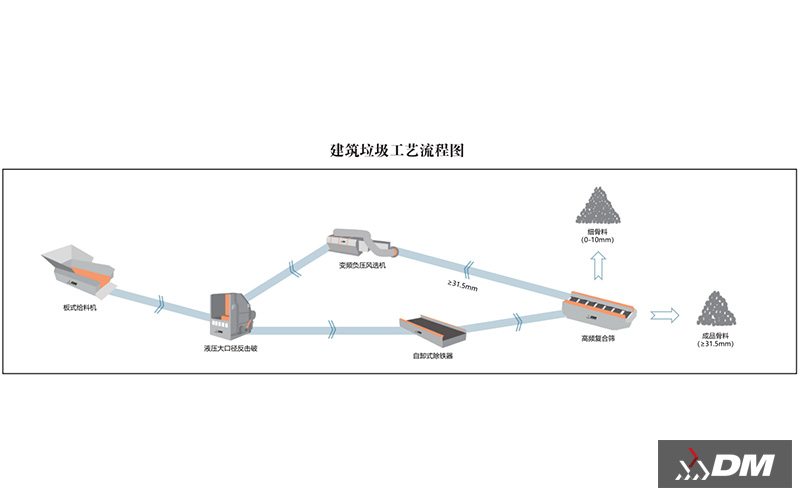
Old‑concrete blocks frequently contain embedded steel bars, iron wires and nails. Equipped with iron‑removal attachments, the crusher releases metal parts from concrete aggregates during crushing. Magnetic separators automatically draw away metallic impurities. This prevents hard metal fragments from damaging subsequent sand‑making machines, and recycled steel can also be resold for extra project income.
3. Manufacture qualified manufactured sand and recycled aggregates
Construction‑waste crushers carry out primary and fine crushing in stages, turning waste bricks into recycled gravel and manufactured‑sand of various specifications. After shaping treatment, aggregates feature full‑bodied grains and a low proportion of flaky particles. Finished aggregates can serve as road‑base filler, permeable‑brick raw material, back‑fill gravel and common‑sand aggregate for mortar. The recycling eases exploitation pressure upon natural sand‑stone resources.
4. Process many kinds of complex solid waste
High‑performance construction‑waste crushers deliver outstanding material compatibility. Apart from ordinary concrete and red‑brick debris, they are suitable for granite leftovers, cement lumps, tile scrap and lime residue. Shanghai Dongmeng optimizes the crushing‑chamber framework to avoid material blockage even for damp, muddy construction waste and adapts to complicated working‑site conditions.
5. Cut transportation expenditure for construction waste
Mobile construction‑waste crushers can travel straight into demolition sites and conduct on‑site crushing. Waste no longer requires long‑distance haulage to landfill yards, which saves substantial earth‑moving fees. Meanwhile, it reduces road dust pollution and traffic congestion caused by waste trucks, well‑suited for district demolition and short‑term road‑renovation projects.
6. Support eco‑friendly production and environmental‑pollution reduction
Open‑air stockpiles of construction waste easily generate flying dust, and rain‑water run‑off pollutes local soil and underground water. Modern‑day construction‑waste crushers may be fitted with sealed casings, water‑spray dust suppression and pulse dust collectors to control dust during crushing. Recycled solid‑waste lowers landfill volume and satisfies environmental‑protection policies for green mines and waste recovery.
1. Choose fixed‑type or mobile‑type machines according to your worksite
Fixed crushing units are ideal for long‑term dedicated construction‑waste disposal plants. Crawler‑mounted mobile crushers are preferred for frequently‑shifted and scattered construction sites, since no concrete foundation is needed and equipment relocation becomes effortless.
2. Prioritize wear‑resistant spare‑part quality and anti‑blockage capability
Construction waste contains plenty of mud and impurities which speed up wear on liners and hammer heads. Crushers from Shanghai Dongmeng adopt high‑hardness wearable components and optimized material passages to cut downtime for maintenance and guarantee stable operation of the full production‑line.
Conclusion
To sum up, construction‑waste crushers perform multiple duties including bulk‑size material crushing, metal separation, recycled‑aggregate preparation and on‑site waste disposal with low‑pollution production. When purchasing machinery, buyers may get in touch with a qualified construction‑waste crusher manufacturer and acquire custom‑built crushing solutions based on raw‑material categories, hourly processing capacity and construction‑site environments.
Related Articles
What Market Advantages Boost Construction Waste Treatment & Resource Recycling?
2026-06-03 More+Urban reconstruction generates massive construction waste, and construction wast...
What procedures are required for a construction waste treatment plant?
2026-04-24 More+The establishment of a construction waste treatment plant (resource recycling &a...
Shanghai Dongmeng Wheeled Mobile Crushing Plant: High-efficiency and Low-cost Solutions for the Sand and Solid Waste Industry in 2026
2026-06-10 More+In 2026, China’s sand production, mining, and construction waste recycling indus...
What does construction waste include? What impacts does it have on the environment?
2026-04-24 More+Construction waste mainly refers to solid waste generated during building constr...